Tuesday, February 12, 2013

The Official Soap Recipe


            One of the most important goals of Peace Corps is to promote sustainable development—changes that will last after the volunteers leave. In my branch of Peace Corps Paraguay, the agricultural sector, one of the ways that sustainable development, or sustainable agricultural plays out is by working with the Paraguayans to use the products from their farms and communities as efficiently as possible, to create as much of a closed circle as possible. One way to more efficiently use farm resources (and increase the yield of an individual farm) is to maximize on the “by-products” of family farms. For example, waste products such as cow manure, fallen leaves, and vegetable scraps can be combined to make amazing fertilizer to increase the vegetable production in the garden or field. And the left over fat (tallow) from meat can be used to make soap (which is cheaper and possibly less “chemically” then the soap at the store).
            Speaking of soap…I have been itching to learn how to make soap since I’ve been in Paraguay. So, I was very excited when Mark and Susan from Arazape (a community that is about ½ hrs drive north of me) invited me over to try it out. Susan has made soap many times in the states, however, she always made soap using different vegetable oils. This would be first time for both of us using tallow. We figured, we would try it out once on our own and then teach the recipe to our communities. Susan had procured the recipe from another volunteer who had made soap with his woman’s commission, and so, after buying some lye and tallow from the local hardware store and butchery (respectively), we were ready to go.

The Official Recipe for Tallow Soap   


  • Melt down cow fat in a large pot.

  • Combine lye with water in a glass container.

  • Dice up herbs and grind up some oatmeal to improve soap’s smell and add some gritty scrub.
  • Check recipe to make sure you have followed exactly all the steps.
  • Pour lye mixture into tallow.
  • As your soap boils and bubbles over into yard, stir rapidly.

  • Back away from smoking brew.

  • Add herbs.

  • Scrape hardening foam off of lawn and add back into pot, adding a couple spoonfuls of boiled grass and dirt.

  • Attempt to find original recipe with snail-speed internet connection.

  • Pour foamy brew into molds.

  • When foamy brew cools down and is obviously planning on remaining a cold foamy brew, re-melt on the stovetop.

  • Pour back into molds.
  •  Let cure for a week and enjoy.
  • Optional: find a new recipe.
Photos taken of me by Susan Alves from twokeepgrowing.blogspot.com

Tuesday, February 5, 2013

Howto Stay Cool in Paraguayan Summer


                It gets very hot in Paraguay in the summer. I’m talking like 100+ on a daily basis, without AC. While I love Paraguay, and I know that I willingly put myself into the Peace Corps, and therefore accepted this situation upon myself, it is still very hot. Luckily, over the past year, I have picked up some traditional and not so traditional coping strategies to deal with the blazing heat of summer in Paraguay.
My original Coping Method:
·         Sitting in a chair, with my mouth open in disbelief, thinking “It can’t possibly be this hot?
o   Pros: holding still/not over-exerting yourself in hot weather is a very important step of heat-stroke prevention.
o   Cons: catching flies.

More Successful Methods:

·         The Mango Method: find your local mango tree and parking there from 10am-4pm

 
o   Pros: mango trees are magical creatures that create their own air-conditioning. While the rest of the air might be still and stagnant, there is always a fresh, cool breeze beneath the lush foliage of a mango tree. This is a good way to make friends with many community members who use this same strategy. The addition of a hammock makes a mango hangout almost irresistible.
o   Cons: mango season—suddenly in January, when you most need the magical tree, you need a helmet to enjoy the shade. Ripe mangos falling from more than 30 feet are not gentle.
·         The Tea Circle Strategy: drink ice-cold terere (tea)


o   Pros: cold, delicious, and communal rehydration. Often combined with the mango tree method.
o   Cons: after 3 or so pitchers the diuretic qualities of terere kick in. Quarter-hourly pee-breaks can be complicated if your bathroom is see-through.
·         The Herbal Remedy: A leaf in your cap


o   Pros: place a couple amba’y leaves in your hat and you are good to go in terms of sun protection. Amba’y trees are pretty abundant: most families in my community have one growing in their backyard.
o   Cons: might garner some strange looks in urban settings.

·         The Guapa Way: Do everyone’s laundry (guapain PYan Spanish means hardworking, not sexy. Though of course, the two aren’t mutually exclusive). 


o   Pros: kill three birds with one stone with a 2-3 hour laundry session. By the time you are done, you will have cleaned a week’s worth of clothes, you will have had a good upper-arm work-out, and you will be soaking wet and cool.
o   Cons: you really need a shady area for this one. Otherwise you will have 2-3 hours –worth of sunburn.
·         Chef’s Specialty: cooking outdoors


o   Pros: keeps the heat away from the house.
o   Cons: firing up the tatakua, the outdoor, clay oven, uses a lot of firewood and takes a lot of time. Therefore, it is not so convenient for everyday use.
·         A Layered Approach:


o   Pros: light colored long sleeve shirts and pants protect you from the sun, keep you modestly dressed, and according to some create a micro-climate/air-conditioning system using merely your skin, sweat, undershirt, and overshirt.
o   Cons: twice as much laundry.
·         Visualization: snow-angel meditation
o   Pros: this method is portable and great for bus-rides
o   Cons: if you are Paraguayan, you probably have never made a snow angel before. Additionally, after a 5 hr no-AC busride (that should have only taken 3.5hrs!!)passing through high-noon, the image begins to fade.
·         The Honi-Method: rain-dances and circles in the sand.
o   Pros: a strong afternoon shower, called “aguacero,” can keep temperatures down for the rest of the afternoon and even the following day. Not only does this shower rejuvenate your sanity, but it also brings some life back into the field crops.
o   Cons: stares/gossip from neighbors as they watch the “nortetavy” (crazy northerner) doing something weird, once again. Also, if the rainfall comes with high winds, you will probably lose power, jeopardizing the contents of your fridge/freezer and leaving you without a fan and therefore vulnerable to major mosquito attacks until power returns.

Friday, November 9, 2012

The Art of the Lunch Crash


       The story about the Jewish cemetery in Prague goes that once upon a time, when a famous rabbi of Prague was on his deathbed, he asked as his parting wish to be buried at the side of his beloved teacher, who had long ago been interred in the Prague cemetery. The only problem, the space at both of his sides was already filled. However, a miracle occurred, the earth spread, and there was space for the student to also be buried beside his teacher. This story (le’havdil) could be taken as analogy for Paraguayan hospitality, especially surrounding meal times. There is always room for more at the table. In fact, chances are, if you find yourself at a Paraguayan’s house before 9:30, you will be eating a second breakfast. If it is after 9:30, you will be invited (sweet-talked, guilted, stared-down) to stay for lunch.
            One of my host-mom’s, Ña Rafaela, takes this type of hospitality to a whole other level. Sometimes when I show up, there are immediate family members, multiple cousins (who have their own moms making lunch as well), in-laws, boarders (they were actually staying with other families, but somehow in the end, moved into Rafa’s house), grandchildren all smished around the table. I don’t think any of them called ahead. I certainly didn’t. And yet, everyone is able to get seconds and thirds. I think maybe Rafa just senses from the wind that she should add another cup of rice to the soup.
            While sometimes PC’s innocently come to work with a community member in the morning and just end up getting invited to lunch, sometimes (especially when it is either really hot out, it’s a traditional PYan holiday, or when I have a really bad cold) it is more intentional: the art of the lunch crash. I mean, there is nothing better for a bad cold then really hot gizo—chicken or beef soup with rice. Cooking it on the gas stove just doesn’t taste the same. I also love to lunch-crash because that is how I’ve learned how to cook some different Paraguayan dishes and also learned about living “close to the earth.”


In my community, meals are generally cooked over the fire—fueled by firewood. Paraguay, is 95% deforested currently. Educating about trees, reforesting, and planting trees here is so important. Since trees are scarce, much of the firewood is collected from dry/fallen branches or from trees that can regrow after partial shearing. 


Vegetables are seasonal—as in, in the summer it is too hot for vegetables to grow in Paraguay without a sun-shade. In the winter, 99% of my community cultivates gardens. Ña Rafaela’s garden is one of the largest in my site—she expands every year. Here she is harvesting cabbage for our salad.

Ña Rafaela’s oldest daughter and her first cousin chopping together.

No food is ever wasted. When I first attempted to make composts with some community members, I learned that whereas suburban Americans might have lots of leftover vegetable scraps to compost, many of the food scraps here are earmarked for various livestock. Chickens, for example, love to crunch on the remains of leafy greens such as cabbage (or on the leafy greens themselves if the garden doesn’t have a good fence!).

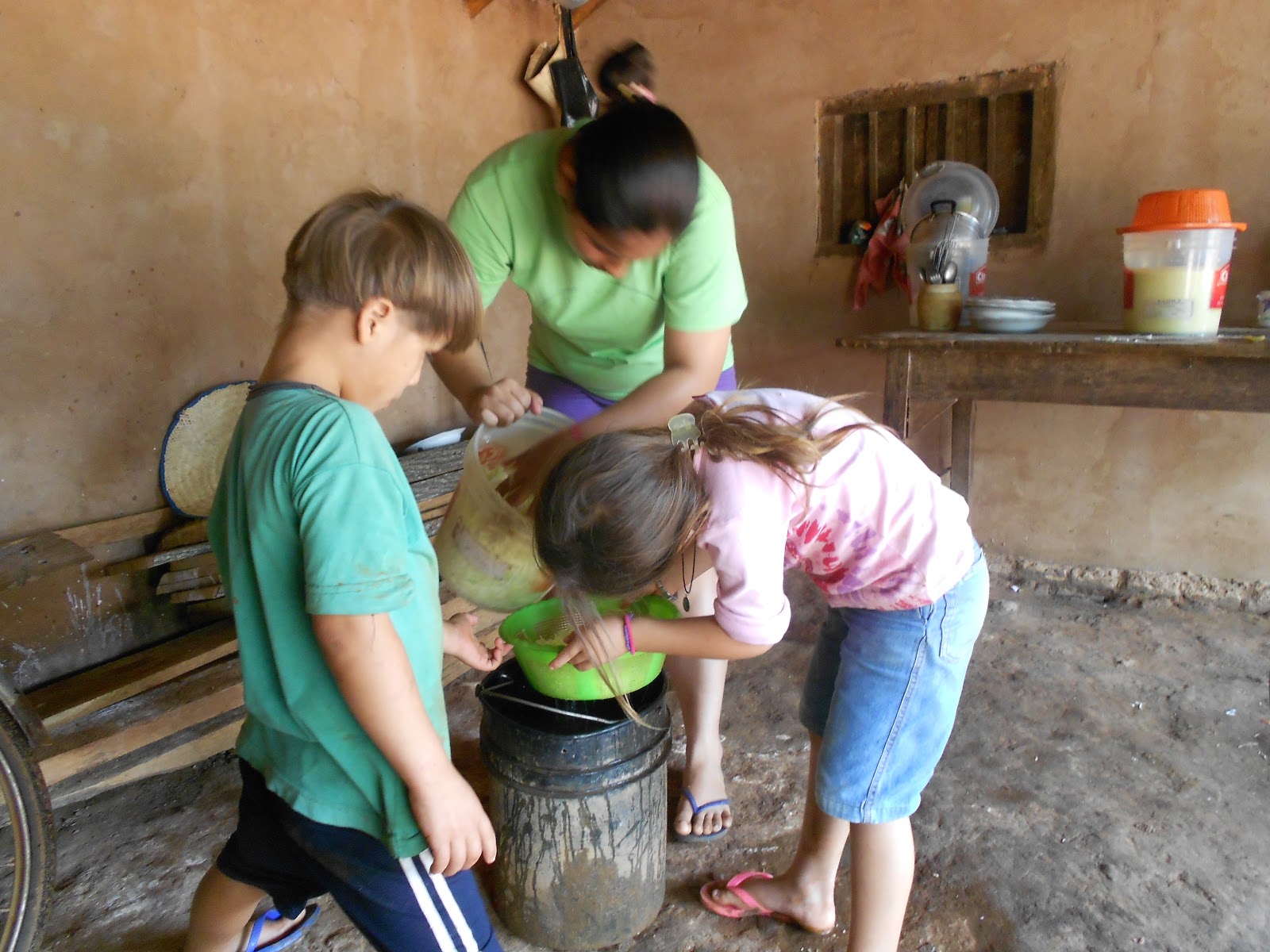
You never know how something might be repurposed or multipurposed here. This bucket makes a perfect gigantic salad bowl.

Although there is running water in my community, the water is pumped from a special type of deep well (about a 5 minute walk from Rafa’s house) and then runs to individual houses. If the power goes out, as it often does in this rainy spring weather, or if Rafa’s nephew forgets to reset the meter, the water stops. Here Rafa’s daughter drains the wash-water from the greens to use for soaking dishes.

Lunch time! Today (in addition to myself), there were cousins and in-laws at lunch.

In parting…

Happy thanksgiving from the Paraguay (I will be celebrating with by attending a Lady Gaga concert…)

And here is my favorite smile in all of Ysypo Potrero (Rafa’s son). 

Thursday, October 25, 2012

Santa Ara


Happy October 24th! What is October 24th, you might ask…October 24th is the day of Saint Rafael, the patron saint of my community Ysypo Potrero. According to the 2002 census (and according to Wikipedia) 89.9% of the Paraguayan population is Catholic. However, this doesn’t mean that everyone is “practicing.” In many ways similar to the Israeli experience of Judaism, in many cases this means that Catholic traditions are part of people’s identities, an underlying narrative, but not necessarily “commandment” status. In my community, there is mass once a month, weekly first communion classes run by volunteers from the community, and a pro-Church committee that raises money for maintenance fees, organizes when the traveling Father is going to come, and keeps the keys to the building.
Despite the chiloni (secular/cultural) flavor of Catholicism in my community (even when there is mass, most community members don’t attend), Ysypo Potrero like most communities in Paraguay has a patron saint, a Catholic saint (intermediary with god) who watches over the community. Ysypo Potrero’s saint is Rafael archangel—a seraph/angel who appears in Jewish tradition as well (c.f. short songs section of Anim Zmirot bencher). 

As the name (in Hebrew) implies, Rafael is specifically connected with healing. In Catholic tradition, every saint has a special day that is their festival, and since Rafael is the patron saint of Ysypo Potrero, that means we have a special mass/celebration here on the 24th of October, the santa ara (Saint’s Day in Guarani). 

Everyone gathers at the church and listens to the army band


Because it is a special mass, it is common for families to baptize their children on this day.


Milena looks a bit nervous.


Getting Saint Rafael’s statue ready for procession (sorry for the blurrr).

Marching with the Saint. Unfortunately this march was pretty short because it’s been raining a lot and there was a ginormous puddle in the road.

Fireworks…


Baptizing Milena…does it count if she’s asleep?


Post-baptism, note Trader-Joes box recycled to hold brownies. Erminio, I am told, was a fan. 

Friday, October 19, 2012

What I´ve Been Up to For the Last Month


Green Manures:  The Real Magic Beans
                Hello once again from Paraguay! This week has been a walk down memory lane as I got a visit from a volunteer-in-training. That’s right my “sister-G” the next round of Agriculture volunteers, have been in Paraguay for about two weeks. As part of the training they get to visit current volunteers twice: once for a short visit by themselves (that was this week) and then again with three other trainees and a language teacher (in November). The idea of the first visit is just to take a rest from the hectic training schedule, get to see “what volunteer life is like,” and learn more about Paraguay. The second visit has more of a language focus—trainees stay with a Paraguayan host family for three days, give a presentation in Guarani or Spanish, etc. Anyway, it was pretty fun to have a visit from a trainee “fresh off the plane” and remember how nervous I was back then and how new and different everything was in Paraguay. Also my trainee visitor was awesome and she taught me how to play rummy.  It was a great week!
                Last week I just finished up a five week class on green manures which has been my biggest (successful) project so far in site. During my “needs assessment phase” when I went and talked to many of the families in the community, it became pretty clear that people had noticed a lack of fertility in their fields. Or rather, they weren’t getting an ideal amount of produce from their fields. Many of the families here have been farming their land constantly for decades, so it’s not surprising that the soil is a little low on plant nutrients. One of the ways of fertilizing fields (organically/low cost) is with manure. While many families do put cow and pig manure in their fields, they generally don’t have enough manure to really provide enough fertilizer for all their fields (most people have 3 cows or less and same with pigs).
As I have mentioned previously, another way to return nutrients to the soil is through the use of green manures/cover crops—there are plants that cover the soil fast and when they are cut down, the rotted remains add nutrients to the soil (like a large scale compost pile). Cover crops related to beans (such as vetch and clover commonly used  on organic farms in the states) actually make their own nitrogen, one of the most important nutrients for plant growth, and add it back into the soil. Since my site is very near a city with a branch of the Department of Agricultural Extensionists, of course many people have heard of green manures. However, most of the farmers in my community have not tried using green manures in their fields or they aren’t familiar with many varieties. There are perhaps a hundred reasons why people don’t use green manures in my community. Two reasons I could address: lack of familiarity/education about soil (why it would be important to use cover crops) and lack of a consistent source for seeds).
I decided to teach a five week class (meeting once a week) about green manures, where participants would receive seeds for seed production after attending three classes. I didn’t have enough seeds to give people for a whole field, but if they planted and produced seeds this year, the farmers would be able to plant a whole field of green manures next year. The classes were really fun. It was a great way for me to see who was excited and interested in green manures and get to know some community members a bit better. It was definitely a challenge to present in Guarani for an hour (because I get stage fright in English!). Sometimes, I would look at people and realize that while I believed I was speaking in Guarani, they clearly had no idea what I was trying to say. But I also watched people learn new things about their soil and crops, and through repetition and review, they seemed to retain the concepts—such as plant families (did you know that tomatoes, potatoes, eggplant, and peppers are all in the same family?!), nutrients in the soil, etc. During my favorite class, I had participants draw their fields and throughout the class, they marked where they wanted to plant green manures and what variety would best serve there.
Next step: visiting all the participants to see if they planted the seeds/have any questions…stay tuned.